On 20 April 2020, the spot price of WTI Crude went negative. This was the first time in history for this to happen and the phenomenon was attributed to the fact that the world was in the throes of the COVID pandemic and associated lockdowns. The demand for oil had collapsed due to the severe contraction in economic activity and at the same time, Russia and Saudi Arabia entered into a price war where Saudi Arabia declared a price decrease per barrel of oil on 8 March 2020. This severely impacted the price of both WTI and brent crude and two days later in an escalation of tensions both Saudi Arabia and Russia announced that they would increase production of oil.
The effect of the contraction in demand and oversupply of oil, along with uncertainty around available storage at Cushing, Oklahoma let to the unprecedented situation where producers were willing to pay buyers to take delivery of WTI crude oil. With most oil trading occuring via the NYMEX futures market and with the May 2020 contract closing on April 21, 2020 sellers of the contract became desperate to close their contracts and avoid physical delivery. This resulted in the May futures contract price going into freefall and closed the day at -USD 37.63 per barrel. The June expiry contract by contrast closed the day at USD 20.43 per barrel.
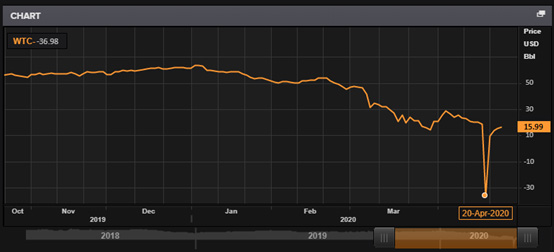
Due to liquidity, numerous traders performed trades in the near month futures and rolled their positions by closing out the near month contract and purchasing the following month. This type of trade may be the reason why the price recovered speedily.
Impact on futures contracts that utilise WTI crude oil as an underlying asset
Future contracts as derivative instruments derive their value from an underlying or reference asset. In the case of the WTI crude oil future, the futures price is calculated from the spot WTI price as well as a component called the carry cost. This relationship may be represented as follows:
$ \text{Futures Price} = \text{Spot Price} \times \left(1+\text{Risk-free rate} + \text{Storage cost} \right) $
Assuming that the risk-free rate of interest were very close to zero along with no convenience yield (a rate used to explain when future prices are lower than spot prices), the resulting futures price is expected to be driven mainly by storage cost considerations.
At the time the May delivery went negative, the June contract was not trading in negative territory. A possible reason for this could be the fact that rolling trades in the June contract were skewed towards buyers (pushing the price up) versus the May contracts where producers sellers headed for the exit at any price that the market presented in order to cash settle their exposure and avoid physical delivery (and storage costs by extension).
Brent Crude Oil vs. WTI Crude Oil
Brent crude is the benchmark crude for northern Europe and is produced in the North Sea between the UK and Norway. Despite it also being affected by the COVID restrictions, Brent crude has greater access to storage and greater buffers to absorb demand shocks.
Brent Crude settled USD 26.21 per barrel on 20 April 2020. On April 21, it dipped lower to USD 9.12 per barrel but never went into negative price territory.
A possible explanation for this is that Brent crude is used in many more territories when compared to WTI and also has access to greater storage facilities.