The features and uses of benchmark rates in financial markets
According to the Cambridge Dictionary, the term benchmark is defined as a standard for measuring or judging other things of the same type. By extension, a benchmark rate is a rate from which other financial transactions are measured or, more accurately, valued. Oftentimes, this rate is also referred to as a reference rate and is used to determine the pay-off in various financial contracts.
In the capital markets, government debt rates are often used to construct a yield curve for different tenors and used to price financial contracts with similar maturities and pay-off profiles. In the interbank market, the LIBOR rate originated in the 1980s to serve as a benchmark rate for syndicated loans.
A ‘good’ benchmark rate would be one that satisfies firstly a requirement of liquidity. It should also be a rate that cannot be manipulated by the parties using it as a reference for the pricing of instruments and according to an IOSCO report a benchmark should be “anchored in an active market having observable, bona fide, arms-length transactions” .
- Why markets chose to move away from LIBOR
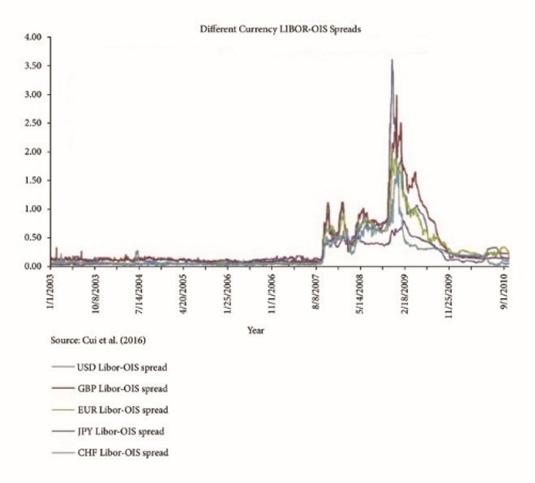
With the publication of Gyntelberg & Wooldridge in March of 2008, the authors reported on a divergence between the interbank LIBOR rate and Overnight Indexed Swap (OIS) rates. (Refer to Figure 1 below). Shortly afterwards, on 16 April 2008, an article appeared in the Wall Street Journal that made allegation of numerous LIBOR contributing banks underreporting on the rates that they were paying on short-term loans. Due to the importance of LIBOR and its near ubiquitous usage all over the world, the allegations were taken seriously, and further investigation revealed that banks were taking advantage of the fact that the quotes submitted to the British Banker’s Association (BBA) were non-binding (the rates weren’t being transacted on) and many bankers exploited their submissions to benefit their own derivative positions. These actions constituted a major form of misconduct as an estimated USD 500 trillion in derivatives were being priced off the LIBOR rate and banks with positions in these contracts could manipulate their own liabilities.
Many contributor banks were also unwilling to lend to one another despite submitting quotes to the BBA. These actions revealed another major flaw in the calculation of LIBOR: despite interbank credit being frozen banks continued to submit LIBOR rates to the BBA that were unrealistically optimistic . Not all of these submissions were intentionally fraudulent, as many representatives tried to submit rates that were in the midpoint of where they thought the rate ought to be in order to ensure that the bank’s creditworthiness not be called into question. - Phasing out issues for FM and derivatives markets as a whole and key challenges
In order to restore confidence in the interbank market, policymakers were faced with numerous questions to address in order to phase out LIBOR. One of the issues were whether the new rate should be similar to LIBOR, in other words, reflect bank credit risk or whether it should be a risk-free rate in the vein of OIS . Other key challenges considered were whether the replacement rate(s) should be uncollateralised or collateralised. Should it constitute a single rate or composition of multiple rates; should it be for multiple maturities or quoted on an overnight basis; and should it represent actual market transactions or rely on discretionary submissions?
Another issue is the question around legacy financial contracts. The legal ramifications of changes to the reference rate while numerous contracts are ongoing and still an area of significant concern in various jurisdictions. - Replacement benchmarks for LIBOR around the world
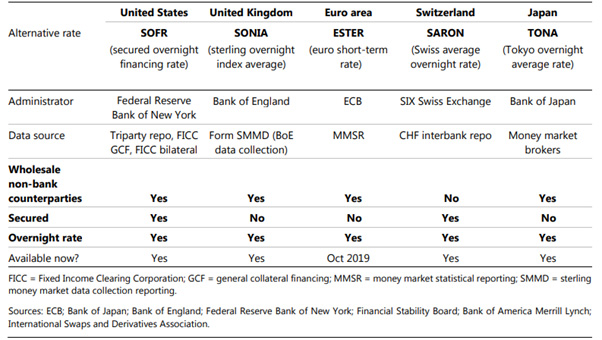
The LIBOR transition required transparency and credibility in the new rates and markets are in the process of transitioning to overnight risk-free rates (RFRs). In Australia, the key interest rate benchmarks are the bank bill swap rates (BBSW) and the AONIA cash rate.
In a number of jurisdictions, it has been deemed feasible to opt for a two-benchmark approach. This has been done to supplement the RFR with a credit-based rate similar to LIBOR. The two-rate regimes aim to include offer rates that are ‘fit-for-purpose’ and align with the pricing profile of contracts that exhibit counterparty credit risk. For an overview of RFRs around the world refer to Figure 2 below . - Proposed alternatives and differences in strategy
In order to protect markets from manipulation, the rate reform process require rates to be based on actual transactions and liquid markets. Another improvement is that a larger number of banks are contributing to market data and these rates go beyond the interbank market which in turn improves representation. In most instances, the rates are also collateralised where LIBOR used to represent an uncollateralised rate.
Concerns with derivative instruments
A major concern with the new RF benchmark rates is that they do not closely match the marginal funding costs encountered by banks and therefore constitute a concern to balance sheet managers that are required to utilise interest rate swaps in hedging interest rate gaps in the banking book and are also for transfer pricing. In the past, the forecasting and discounting of cashflows associated with various derivative instruments were performed using a single benchmark rate. The liquidity constraints and concerns around interbank liquidity has necessitated the use of different curves for the forecasting and discounting. This has given rise to more complex multicurve frameworks.
A shortcoming of the OIS rates is the fact that these rates are overnight and do not match the money market time profile that LIBORs used to provide. It is also crucial from a financial stability perspective that robust fullback clauses be inserted into existing legacy contracts.
Potential advantages of IBOR transition
An important benefit that is expected to arise due to the new regime’s use of real overnight rates from the repo market, it is expected that RFRs will provide a true indication of market conditions.
In recent times it has also become necessary for many banks to centrally clear OTC derivative contracts. This has inadvertently had the effect of reducing credit risk and circumvented the lack of representative credit risk in OIS rates.